At Lexington Reception Services (LRS), service is not a script, it’s a behaviour. That principle sits at the core of our long-standing partnership with training specialists Purple Story.
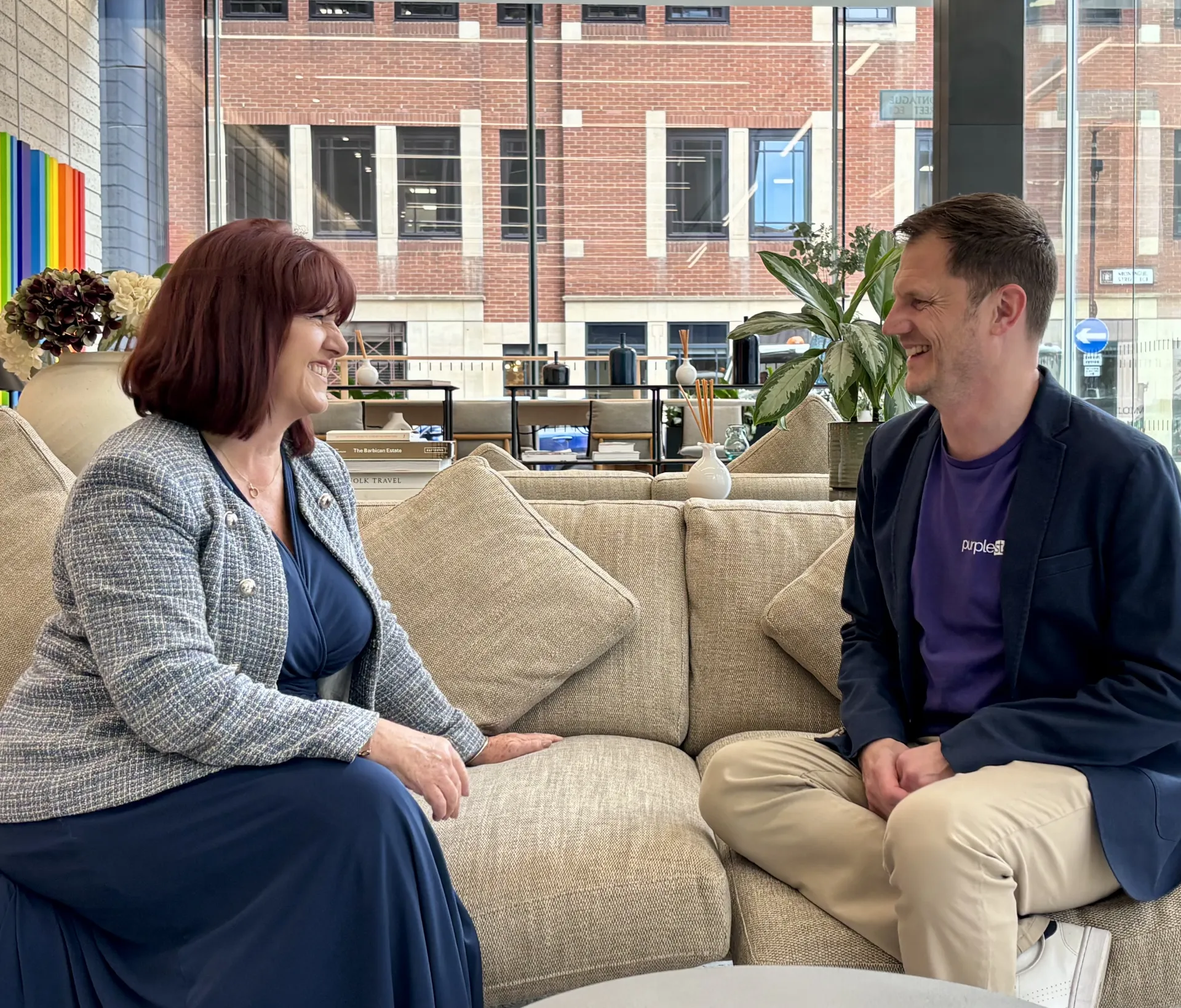
We brought together Jane Streat (Head of Client Services, LRS) and Craig Wells (Operations Director, Purple Story) to discuss how the partnership works in practice from design through to impact, and what it takes to embed a service culture that endures.
Origin of the Partnership
Q: From your perspective, what made this partnership the right fit?
Jane Streat (LRS): “It goes right back to the beginning of LRS, and even before that. There’s always been a strong relationship and a shared belief in putting people at the centre of everything we do. That alignment makes it easy to design programmes that genuinely reflect our culture and standards.”
Craig Wells (Purple Story): “The two businesses approach service in a very similar way. It’s not about ‘one size fits all’, it’s about tailoring the experience. Service is behavioural, not procedural. That’s where the alignment sits.”
Designing the Programme
Q: At LRS we have expanded the Purple Story programme with 2 more modules this year. How do you translate brand and service ethos into a structured training programme?
Craig: “It starts with immersion. We spend time understanding the culture, the language, and the environment whether that’s through conversations or being on-site with teams. From there, it’s about continuous listening and refining based on feedback. The programme evolves with the business.”
Q: What needs to be customised for different client environments?
Craig: “Every environment is different. Training must adapt to the room, not follow a rigid script. It has to work around operations, not disrupt them. And importantly, it needs to be inclusive, bringing concepts often reserved for senior leaders down to frontline teams in a meaningful way.”
Delivery and Adoption
Q: How is training delivered, and how do you ensure consistency?
Craig: “For LRS, consistency comes from having dedicated facilitators who understand the client deeply, how they operate, how they communicate. More broadly, while we do deliver some virtual sessions, face-to-face training drives stronger engagement. It’s about facilitation, not just delivery.”
Q: How do you move from training to sustained behavioural change?
Jane: “Training gives teams the space to think differently. They discuss real scenarios, take that back into the workplace, and see results. Once they see it works, the behaviour sticks. It’s about creating that ‘moment of realisation’.”
Q: What role do managers play?
Jane: “They’re critical. If managers don’t live and breathe the behaviours, it won’t land. Teams follow what they see. Its still true to this day, you naturally follow the lead of someone you respect in whatever it is, in whatever situation, if you see that person’s behaviour, you tend to learn it, especially if you work in their team. Managers need to lead by example and create an environment where training is seen as a benefit, not a tick-box.”
Craig: “Managers are the multiplier. We deliver the training, but they sustain it. Their role is to coach, reinforce, and bring the ‘why’ behind the behaviours to life day-to-day.”
Impact
Q: What tangible changes have you seen?
Jane: “We’ve seen teams become more confident and more innovative. They’re speaking up, sharing ideas, and solving problems themselves. That shift from waiting to be told, to taking ownership is significant.”
Q: Any specific examples?
Jane: “One simple but powerful change was awareness at reception. We used to see the tops of heads, people focused on screens. Now teams are consciously present. They even introduced what they call the ‘meerkat approach’, ensuring someone is always looking up and engaging. It’s a small change, but it transforms the client experience.”
Q: How do you measure success?
Craig: “There are immediate indicators, session feedback and engagement levels but the real measure is what happens afterwards. When we return and hear stories of behavioural change or see improved performance, that’s success.”
Jane: “For us, it’s visible. You see people enjoying their roles more, being present, and delivering service naturally, not in a forced or scripted way.”
Why Invest in External Training?
Q: Why partner with a specialist like Purple Story?
Jane: “Internal training covers the fundamentals well, compliance, safety, core skills. But customer service in our environment is different. It needs to be tailored, relevant, and engaging for frontline teams. Purple Story understands that. Without that relevance, you lose engagement.”
What Sets Successful Organisations Apart?
Q: From a training perspective, what differentiates organisations that successfully embed service culture?
Craig: “It’s those that see training as continuous, not a one-off event. And where leadership is actively involved, modelling behaviours, reinforcing standards. That’s where you see real impact.”
The Role of Technology and AI
Q: How do you see service training evolving with technology and AI?
Craig: “I could go on for ages about this, but I won't. We are starting to produce workshops that talk about AI in the workplace, and how to use AI as a critical best friend as clients adapt and change. We are also adapting to this as a business that is utilising AI in how we function as an organisation. For us, as a small business, we use AI to improve the way we work by implementing automation for the more repetitive tasks, which allows us to focus on training and creating more impactful programmes.
Technology can remove the transactional elements, but it can’t replace the human aspects - judgement, empathy, reading the room. If anything, it makes those human skills more valuable.”
Johan Joubert (LRS): “AI is such a buzz word at the moment, but for me its all about data. AI should deliver insights based on all this data we are sitting on and enhance decision-making and strategic planning. We sit on vast amounts of data: feedback, performance, behaviours. The opportunity is using that data to refine training and improve outcomes, not losing sight of the human experience.
And in terms of tech, I am a very firm believer in the fact that tech should support operations and not replace it. Companies look at tech in isolation, whilst it should be looked at in terms of of the entire customer journey – you cant implement something that will ultimately not enhance the overall experience. And involve the operations teams – they are they ones who knows the experience better than anyone else.”
Continuous Development
Q: How do you refine and evolve the programme?
Jane: “It’s driven by feedback, both from our teams and from clients. If we see challenges emerging, we adapt. For example, modules like Emotional Intelligence came directly from real operational needs.”
Craig: “We formally review every programme, looking at feedback, identifying gaps, and suggesting refinements. It’s an ongoing partnership, not a fixed product.”
Final Thought
Embedding a service culture is not achieved through a single intervention. It requires consistent investment, operational alignment, and leadership commitment.
Katharine Lewis, Founding Director of Lexington and People Lead:
“Service culture doesn’t come from a handbook, it comes from people who genuinely care. Our investment in training is an investment in that belief. When you give your teams the tools to grow, they don’t just meet expectations, they redefine them".
About Purple Story
Purple Story is a specialist training and development company focused on building lasting service culture through behavioural change. Working with frontline teams and senior leaders alike, they design and deliver tailored programmes that go beyond process — helping organisations develop the human skills that technology can’t replace. Operating across the UK, Purple Story partners with clients on a continuous basis, evolving programmes to meet real operational needs as businesses grow and change.
About Lexington Reception Services:
Lexington Reception Services (LRS) is a managed reception and front of house specialist, delivering exceptional guest experiences for corporate clients across diverse sectors within the UK. With a people-first philosophy at its core, LRS partners with organisations to represent their brand from the moment visitors arrive. Founded in 2013, LRS is trusted by some of the UK’s most respected businesses to set the standard in professional guest services.